Abstract
Early-life nutrition is a critical predictor of long-term health, yet the association between rapid early-childhood growth and adolescent obesity, particularly in relation to the “double burden of malnutrition,” remains under-researched in Indonesia. This study aimed to analyze the association between rapid growth and adolescent obesity. Data were obtained from the 1997, 2000, and 2014 waves of the Indonesian Family Life Survey (IFLS). This study included 641 children (aged 0–23 months at baseline) with complete anthropometric measurements across all three waves. Rapid growth was defined as an increase in z-scores of >0.67 in weight-for-age (WAZ), height-for-age (HAZ), or weight-for-height (WHZ) between 1997 and 2000. Multivariable logistic regression, stratified by baseline nutritional status, was used to estimate adjusted risk ratios (aRRs). The adolescent obesity prevalence was 4.5%. Rapid WAZ growth was significantly associated with adolescent obesity (aRR = 4.49; 95% CI: 1.32–15.25), whereas rapid WHZ growth showed a borderline association (aRR = 2.90; 95% CI: 0.87–9.47). Stratified analysis showed that the association between rapid weight gain and adolescent obesity was markedly stronger among children with a history of undernutrition (aRR = 14.99 for WAZ; aRR = 9.52 for WHZ) than among those without. Rapid weight gain during early childhood, particularly in children with a history of undernutrition, is a strong predictor of adolescent obesity. These findings emphasize the importance of integrating longitudinal growth-trajectory monitoring into routine child health assessments to promote healthy growth while minimizing future metabolic risks.
References
1. Lister NB, Baur LA, Felix JF, et al. Child and adolescent obesity. Nat Rev Dis Primers. 2023; 9: 24. DOI: 10.1038/s41572-023-00435-4.
2. United Nations Children’s Fund. Landscape Analysis of Overweight and Obesity in Indonesia. Jakarta; United Nations Children’s Fund; 2019.
3. Badan Penelitian dan Pengembangan Kesehatan. Hasil Utama Riskesdas 2018. Jakarta: Kementerian Kesehatan Republik Indonesia; 2018.
4. Badan Kebijakan Pembangunan Kesehatan. Survei Kesehatan Indonesia (SKI): 2023 Dalam Angka. Jakarta: Kementerian Kesehatan Republik Indonesia; 2024.
5. Halilagic A, Moschonis G. The Effect of Growth Rate during Infancy on the Risk of Developing Obesity in Childhood: A Systematic Literature Review. Nutrients. 2021; 13 (10): 3449. DOI: 10.3390/NU13103449.
6. Hu Z, Tylavsky FA, Han JC, et al. Maternal metabolic factors during pregnancy predict early childhood growth trajectories and obesity risk: The CANDLE Study. Int J Obes. 2019; 43 (10): 1914–1922. DOI: 10.1038/s41366-019-0326-z.
7. Scheffler C, Bogin B, Hermanussen M. Catch-up growth is a better indicator of undernutrition than thresholds for stunting. Public Health Nutr. 2021; 24 (1): 52–61. DOI: 10.1017/S1368980020003067.
8. Ong YY, Sadananthan SA, Aris IM, et al. Mismatch between poor fetal growth and rapid postnatal weight gain in the first 2 years of life is associated with higher blood pressure and insulin resistance without increased adiposity in childhood: The GUSTO cohort study. Int J Epidemiol. 2020; 49 (5): 1591–1603. DOI: 10.1093/IJE/DYAA143.
9. United Nations Children’s Fund. UNICEF Conceptual Framework on Maternal and Child Nutrition. New York, NY: United Nations Children’s Fund; 2020.
10. Sartika RAD, Lubis PN, Wirawan F, et al. The Impact of Rapid Growth After Retardation at the First 1000 Days of Life (FDLs) on the Risk of Noncommunicable Diseases in Indonesian Adolescence. Int J Pediatr. 2025; 2025: 4675199. DOI: 10.1155/IJPE/4675199.
11. RAND. Indonesian Family Life Survey (IFLS). Santa Monica, CA: RAND; 2026.
12. Desmond C, Casale D. Catch-up growth in stunted children: Definitions and predictors. PLoS One. 2017; 12: e0189135. DOI: 10.1371/Journal.pone.0189135.
13. Kepala Badan Pusat Statistik. Peraturan Kepala Badan Pusat Statistik Nomor 37 Tahun 2010 Tentang Klasifikasi Perkotaan dan Pedesaan di Indonesia. Jakarta: Badan Pusat Statistik; 2010.
14. Bentham J, Di Cesare M, Bilano V, et al. Worldwide trends in body-mass index, underweight, overweight, and obesity from 1975 to 2016: A pooled analysis of 2416 population-based measurement studies in 128·9 million children, adolescents, and adults. Lancet. 2017; 390 (10113): 2627–2642. DOI: 10.1016/S0140-6736(17)32129-3.
15. Stoś K, Rychlik E, Woźniak A, et al. Prevalence and Sociodemographic Factors Associated with Overweight and Obesity among Adults in Poland: A 2019/2020 Nationwide Cross-Sectional Survey. Int J Environ Res Public Health. 2022; 19 (3): 1502. DOI: 10.3390/IJERPH19031502.
16. Shi J, Guo Q, Fang H, et al. The Relationship between Birth Weight and the Risk of Overweight and Obesity among Chinese Children and Adolescents Aged 7–17 Years. Nutrients. 2024; 16 (5): 715. DOI: 10.3390/NU16050715.
17. Dare S, Mackay DF, Pell JP. Correction: Relationship between Smoking and Obesity: A Cross-Sectional Study of 499,504 Middle-Aged Adults in the UK General Population. PLoS One. 2017; 12 (2): e0172076. DOI: 10.1371/journal.pone.0172076
18. Biro Komunikasi dan Pelayanan Masyarakat. Ayo Bergerak, Lawan Obesitas. Jakarta: Kementerian Kesehatan Republik Indonesia; 2019.
19. Badan Pusat Statistik. Ringkasan Eksekutif Pengeluaran dan Konsumsi Penduduk Indonesia, Maret 2018. Jakarta: Badan Pusat Statistik; 2018.
20. Ariawan I, Jusril H, Afifa ZI, et al. Intervention Levers for Stunting Reduction in Indonesia: Evidence from the 2023 Indonesian Health Survey Data. Kesmas. 2026; 21 (2): 125–134. DOI: 10.7454/kesmas.v21i2.2686.
21. Bronson SC, Seshiah V. Transgenerational Transmission of Non-communicable Diseases: How to Break the Vicious Cycle? Cureus. 2021; 13 (10): e18754. DOI: 10.7759/cureus.18754.
22. Li N, Zhang S, Leng JH, et al. Effects of rapid growth in early childhood on metabolic and cardiovascular diseases among preschool-aged children. Asia Pac J Clin Nutr. 2020; 29 (3): 558–565. DOI:10.6133/APJCN.202009_29(3).0015.
23. Doñate Carramiñana L, Guillén Sebastián C, Iglesia Altaba I, et al. Rapid Growth between 0 and 2 Years Old in Healthy Infants Born at Term and Its Relationship with Later Obesity: A Systematic Review and Meta-Analysis of Evidence. Nutrients. 2024; 16 (17): 2939. DOI: 10.3390/NU16172939.
24. de Groot JM, Felix JF, Gaillard R, et al. Childhood body mass index trajectories and risk of overweight and obesity in young adulthood: A population-based prospective cohort study. Eur J Pediatr. 2026; 185: 427. DOI: 10.1007/S00431-026-07080-5.
25. Poveda NE, Adair LS, Martorell R, et al. Growth patterns in childhood and adolescence and adult body composition: A pooled analysis of birth cohort studies from five low and middle-income countries (COHORTS collaboration). BMJ Open. 2023; 13 (3): e068427. DOI: 10.1136/BMJOPEN-2022-068427.
26. Zheng M, Lamb KE, Grimes C, et al. Rapid weight gain during infancy and subsequent adiposity: A systematic review and meta-analysis of evidence. Obes Rev. 2018; 19 (3): 321–332. DOI: 10.1111/obr.12632.
27. Zhou LY, Deng MQ, Zhang Q, et al. Early-life nutrition and metabolic disorders in later life: A new perspective on energy metabolism. Chin Med J. 2020; 133 (16): 1961–1970. DOI: 10.1097/CM9.0000000000000976.
28. Handakas E, Keski-Rahkonen P, Chatzi L, et al. Cord blood metabolic signatures predictive of childhood overweight and rapid growth. Int J Obes. 2021; 45 (10): 2252–2260. DOI: 10.1038/S41366-021-00888-1.
29. Suzuki Y, Kido J, Matsumoto S, et al. Associations among amino acid, lipid, and glucose metabolic profiles in childhood obesity. BMC Pediatr. 2019; 19: 273. DOI: 10.1186/S12887-019-1647-8.
30. Wells JCK. Natural selection and human adiposity: Crafty genotype, thrifty phenotype. Phil Transact R Soc B. 2023; 378 (1885): 20220224. DOI: 10.1098/RSTB.2022.0224/23817.
31. Xiao X, Su L. Editorial: Intrauterine nutrition and adult metabolism. Front Nutr. 2022; 9: 1085083. DOI: 10.3389/FNUT.2022.1085083.
32. Marshall NE, Biel FM, Boone-Heinonen J, et al. The Association between Maternal Height, Body Mass Index, and Perinatal Outcomes. Am J Perinatol. 2019; 36 (6): 632–640. DOI: 10.1055/S-0038-1673395.
33. Pradeilles R, Norris T, Ferguson E, et al. Factors associated with catch-up growth in early infancy in rural Pakistan: A longitudinal analysis of the women’s work and nutrition study. Matern Child Nutr. 2019; 15 (2): e12733. DOI: 10.1111/MCN.12733.
34. Maciejewski E, Hamon I, Fresson J, et al. Growth and neurodevelopment outcome in symmetric versus asymmetric small for gestational age term infants. J Perinatol. 2016; 36: 670–675. DOI: 10.1038/jp.2016.48.
35. Marjan AQ, Sartika R. Correlation between Catch-up Growth in Early Childhood with Cognitive Ability among School-Aged Children (10–12 Years): A Longitudinal Study. Open Access Maced J Med Sci. 2022; 10 (T8): 23–29. DOI: 10.3889/OAMJMS.2022.9463.
36. Cooke R, Goulet O, Huysentruyt K, et al. Catch-Up Growth in Infants and Young Children with Faltering Growth: Expert Opinion to Guide General Clinicians. J Pediatr Gastroenterol Nutr. 2023; 77 (1): 7–15. DOI: 10.1097/MPG.0000000000003784.
37. Singhal A. Long-Term Adverse Effects of Early Growth Acceleration or Catch-Up Growth. Ann Nutr Metab. 2017; 70 (3): 236–240. DOI: 10.1159/000464302.
38. Garcia-Iborra M, Castanys-Munoz E, Oliveros E, et al. Optimal Protein Intake in Healthy Children and Adolescents: Evaluating Current Evidence. Nutrients. 2023; 15 (7): 1683. DOI: 10.3390/NU15071683.
39. Luque V, Closa-Monasterolo R, Escribano J, et al. Early Programming by Protein Intake: The Effect of Protein on Adiposity Development and the Growth and Functionality of Vital Organs. Nutr Metab Insights. 2016; 8 (Suppl 1): 49–56. DOI: 10.4137/NMI.S29525.
Recommended Citation
Sartika RA , Wirawan F , Liberty IA ,
et al.
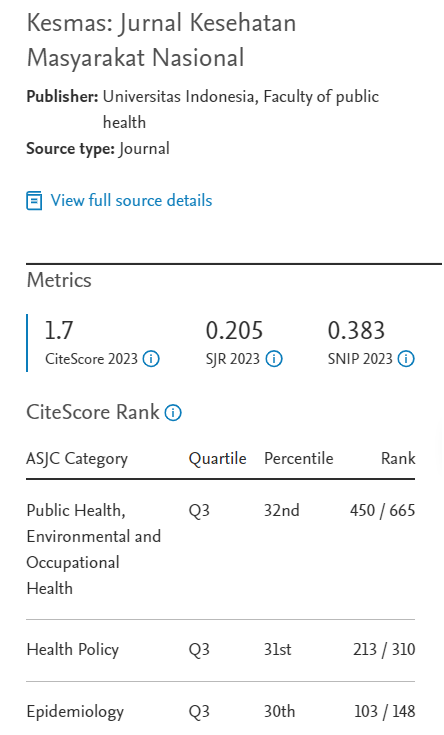
The Association Between Rapid Growth in Children Under the Age of Five and Adolescent Obesity.
Kesmas.
2026;
21(3):
205-214
DOI: 10.7454/kesmas.v21i3.2805
Available at:
https://scholarhub.ui.ac.id/kesmas/vol21/iss3/7
Included in
Biostatistics Commons, Community Health Commons, Maternal and Child Health Commons, Nutrition Commons, Population Health Commons, Women's Health Commons